After 40+ years in this industry, I’ve watched healthcare chase every imaginable shiny object: apps, dashboards, devices, platforms, algorithms. Each one arrives with the promise of transforming how we engage people—especially older adults.
Here’s the truth no one wants to say out loud:
Technology doesn’t change behavior. Trust does.
And trust is the most underutilized asset in American healthcare.
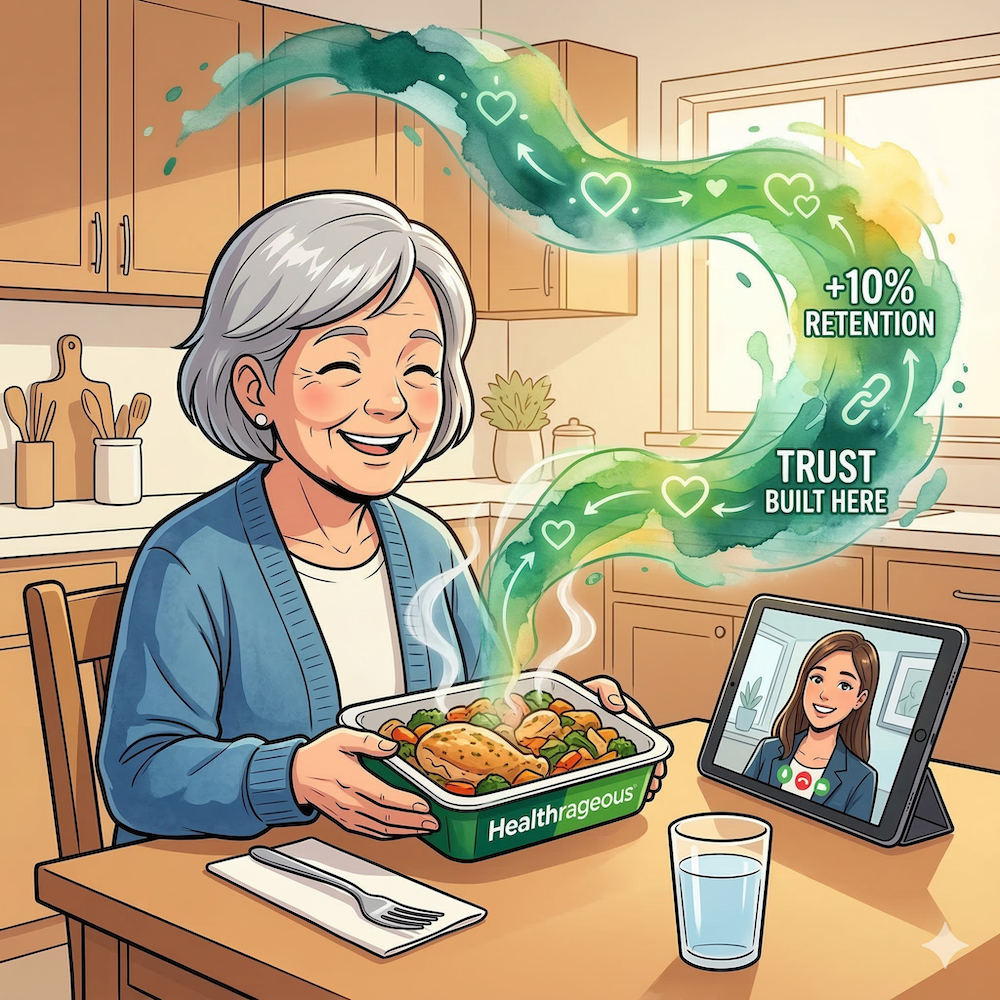
People often mistake Healthrageous for a “meal company.” That’s fine—it means they’re noticing the most visible part of what we do. But the meal is simply the on-ramp.
Food sits at the bottom of Maslow’s hierarchy for a reason. If you’re hungry—or worried about your next meal—you’re not going to be thinking about your blood pressure, your hydration, your medications, or your next appointment. You’re in survival mode.
By solving the simplest need first—calories—we earn something technology alone has never been able to achieve at scale: trust and permission to engage.
That’s essential when you’re trying to reach the 3–5% of members who consistently consume more than half of a health plan’s total medical spend. This has been true since the 1950s and will still be true in the 2050s.
Meals open the door.
Trust keeps it open.
Engagement walks through it.
More than half of Medicare beneficiaries have never downloaded an app to manage their health. Not because they’re unwilling, but because the process is confusing and loaded with friction: usernames, passwords, updates, multi-factor authentication, tiny buttons, and impossible interfaces.
So we cut all of that out.
No apps.
No passwords.
No hoops.
Just SMS, email, or voice call, whatever method the member wants and in whatever language the member wants. That's simple, familiar, and stress-free. It’s the only way to meet older adults where they are, rather than demanding they meet us where we wish they were.
Make something simple enough, and people use it.
Make it supportive enough, and people trust it.
Once someone trusts us, we don’t need long lectures or complex care plans. Nudges—a five-word message at the right moment—move mountains.
“Have you had water today?”
“Take a quick walk.”
“Your appointment is tomorrow.”
These are not groundbreaking statements. But they are grounding. They give older adults the contextual cues they need to act on their own behalf.
In behavioral science, we call this a BOF feedback loop—Behavioral Optimization Feedback. You don’t regulate behavior by penalizing it. You support behavior by framing it. You give a person context, not consequences.
And when you do that, outcomes change.
Across more than 28,000 members, our model delivered:
➤ About $2,000 in average savings per member per year
➤ Significant reductions in ER and inpatient utilization
Why? Because people finally have a way to invest in their own health that feels human—not punitive.
Healthcare spends billions on ways to control behavior.
Very little on ways to inspire it.
We’re proving which approach actually works.
Before someone can manage their chronic conditions, they have to manage their life.
Loneliness is a silent epidemic in the 65+ population. It drives medical costs higher than most chronic diseases. So we built Hello Made Easy, a simple, human solution that gives older adults what they actually need—connection.
We pair people with trained peers who call them weekly. They talk, they laugh, they remember, they feel seen again. That’s what changes health trajectories—not another portal login.
Here’s an uncomfortable fact:
A scatter rug can be as dangerous as a cardiac condition.
A fall often leads to surgery, then complications like sepsis, then a hospitalization that accelerates decline. Many of these events are preventable with simple changes inside the home.
Not everything requires a device or a nurse.
Sometimes it requires noticing the rug no one has moved in 30 years.
Everyone keeps asking how technology can “fix” healthcare.
It can’t—not by itself.
The formula is simple:
Simplicity → Trust → Technology (in that order).
If you earn someone’s trust with a simple, useful experience, you gain permission to introduce technology in a way they actually welcome. And when people feel supported—not regulated—they change their behavior. When they change their behavior, their health improves. And when their health improves, costs fall.
That’s the real transformation.
Not another app.
Not another dashboard.
Not another promise that “this time, digital will engage seniors.”
Engagement is human.
Trust is human.
Health is human.
Technology is what comes after.


Vivamus luctus rhoncus neque, ac euismod ipsum faucibus eget. Vestibulum non libero risus. Aliquam erat volutpat. Donec condimentum, massa eu ultrices fermentum, nisi est vehicula velit, quis viverra mauris diam a quam. Mauris bibendum, est sit amet eleifend tincidunt, ante lorem pretium metus, sed pharetra leo nunc sed massa. Fusce tincidunt mollis felis sed dapibus. Sed vel posuere quam, hendrerit tincidunt dui.
Nullam elementum eu velit eu bibendum. Donec ullamcorper ornare maximus. Curabitur scelerisque, ipsum sit amet dignissim porta, turpis leo volutpat odio, id commodo massa risus ac tellus. Fusce egestas magna ut pharetra tristique. Sed eleifend hendrerit dictum. Quisque dignissim nulla eu euismod mollis.
Vivamus luctus rhoncus neque, ac euismod ipsum faucibus eget. Vestibulum non libero risus. Aliquam erat volutpat. Donec condimentum, massa eu ultrices fermentum, nisi est vehicula velit, quis viverra mauris diam a quam. Mauris bibendum, est sit amet eleifend tincidunt, ante lorem pretium metus, sed pharetra leo nunc sed massa. Fusce tincidunt mollis felis sed dapibus. Sed vel posuere quam, hendrerit tincidunt dui.
Pellentesque ut accumsan nisi. Etiam porta dui metus, vel blandit arcu euismod eu. Mauris pharetra finibus diam. Aliquam lobortis sem non vestibulum suscipit. Ut quis vehicula tortor.